Kenny Cox
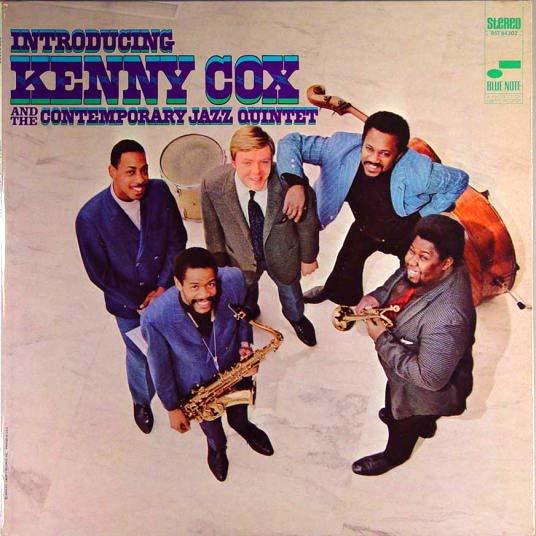
Introducing the Kenny Cox Quintet
This is a really good record from the unknown and rare ish Blue Note side of life
Well worth a listen for its innovation as is his other Blue Note release Multidirection.
Sadly neither are on CD...yet although rare copies can be hunted down for not alot of wonga...enquiries to me!
Here is some more info from a site about the quintet which got named the Contempary Jazz Quintet from http://www.brickhaus.com/deepdish/snuck_in&which_way_what--compositions.htm
The CJQ (Moore/trumpet, Leon Henderson/Tenor, Kenny Cox/Piano, Ron Brooks/Bass, Danny Spencer/Drums) was a very exciting and innovative ensemble active in Detroit in the late 60's/early 70's, They were also involved in sustaining a important artist-run perfomance space in Detroit called the Strata Concert Gallery where I went to hear them every chance I could get.
The CJQ played original compostions (usually by Cox or Moore) that were much more than just tunes, but overall concepts of how an entire ensemble would improvise. This had an expressive as well as formal impact upon the music because the demands of this approach necessitated raising the degree and intensity of group concentration beyond average, habitual common denominators. They were generating music from deeper levels of what's possible in this music. The rhythm section's role and development of the music was as important and as out front as that of the winds. The thinking and impact in this sense was more interactive and more truly orchestral.
The existing recordings don't reveal the actual breadth and energy of what I remember hearing (especially the centrality of Danny Spencer's exuberant and inventive drumming), and unfortunately for us here in posterity, you just had to have been there.
(Recently, Charles told me that MULTIDIRECTIONS was to be the group’s breakout concept album. There was a wholistic layout that allowed the compositions to be extended along the lines of Miles Ahead, Sketches of Spain, etc.. However, how the CJQ had actually wanted to present this music on MULTIDIRECTIONS didn't exactly get the most supportive response from Blue Note as it turned out, and this approach had to be deconstructed for the recording.)
Aethetically African derived musics may be perceived in terms of their close relationship with movement, either in a direct conjunction with dance or as kinetically sculptural in the sense of “dancing in your head” (to borrow Ornette Coleman's title). The CJQ, among other things, was particularly involved with opening up the potentials of what might be expressed and experienced in terms of motion.
(When I was listening to their music back then, I could feel the impact all of this, but what they were actually doing was still over my head. After some years of experimenting with getting to these kinds of sensations through my own music, I got a copy of MULTIDIRECTIONS from Danny and checked it out again.)
The special momentum of Snuck In develops from the dynamic tension among three different varieties of motion:
A 6/4 Vamp
Walking 4/4
3/4 marked by dotted half notes
Each of these states of motion, especially when placed side by side in contrast with each other, carries a distinctive sensation,
Vamps often have an effect of making time psychologically stand still, A vamp defines the size, shape and flavor of a moment, and it keeps coming back, over and over again. Time is going around in a circle. It doesn't go anywhere. Vamps can also function as Spirals in which energy builds up with each repetition, much as water accumulates behind a dam, or as a bow is drawn more taut.
Swinging 4/4 clearly goes straight ahead. In Snuck In, the 4/4 functions as the release of that stationary tension.
The impact of the episodes of 3/4 feels like the brakes coming on, of time moving almost backwards, crashing against breaking waves and such.
Put them all together in sequence at a quick tempo and you get an effect different than any of these particular grooves alone, but something that results only from their combination, Each of the states of motion collides and ripples across each other, as would our own listening dance/metronome sense also ripple across these brisk alterations in pattern, (The asymetrical groupings of 5 measures of 4/4 and 3/4 respectively makes each of these particular episodes a bit more unstable, and the slipping between meters arrives more unexpectedly.) The exact calibration and total effect of these specific alternations between contrasting rhythmic sensations, the overall rhythm of the movements between these varying states of movement, might be called Snuck In’s own particular metagroove.

